Building a custom home or finishing a major addition takes real money. Most people cannot pay cash for a project like this, so they look into financing. Construction loans give you the funds you need, but they work differently than a regular mortgage and come with their own upsides and downsides.
Knowing the pros and cons of construction financing helps you make a smart choice about funding your project. The right approach depends on your finances, your timeline, and your long term plans. Loan rates and lending rules have also shifted somewhat in 2026, so it helps to go in with current numbers instead of what you might remember from a few years back.
At Builders Group Construction, we have worked with homeowners across Dayton and surrounding Ohio communities like Hamilton, Brookville, and Centerville on projects ranging from custom builds to major additions. Our experience gives us real insight into what works and what to watch for. Here is what you need to know about financing your home construction project.
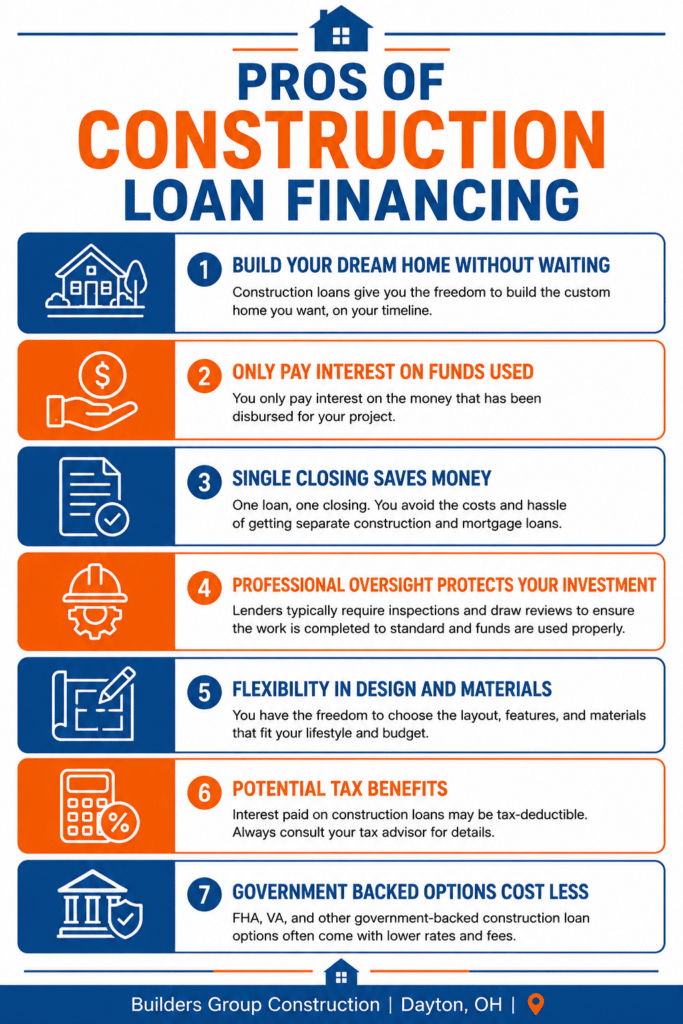
Pros of Construction Loan Financing
Build Your Dream Home Without Waiting
The biggest advantage is simple: it lets you build now instead of waiting years to save enough cash. Financing makes custom building accessible to families who have good income and credit but limited liquid assets. You can create the exact home you want on your timeline.
Only Pay Interest on Funds Used
During construction, you typically pay interest only on money already drawn from the loan. If your loan is $400,000 but you have only drawn $150,000 for site work and the foundation, you pay interest on that $150,000. This keeps costs lower during the building phase when you might still be paying rent or a mortgage elsewhere.
Single Closing Saves Money
Construction-to-permanent loans combine construction financing and your permanent mortgage in one transaction. You close once, pay one set of closing costs, and lock in your interest rate upfront. This saves thousands compared to getting a construction-only loan followed by a separate mortgage.
Professional Oversight Protects Your Investment
Lenders inspect the work at each draw stage before releasing more funds. This gives you a professional check that construction is moving forward the way it should. These inspections make sure a builder finishes work before getting paid, which protects you from a contractor who cuts corners. The same kind of oversight applies to a smaller scale kitchen remodel, where staged payments tied to real progress protect you just as much as they do on a full custom build.
Flexibility in Design and Materials
When you build with financing, you control the design decisions. Unlike buying an existing home where you take what is available, a construction loan lets you specify exactly what you want.
You choose the floor plan, materials, finishes, and features. Do you want a custom kitchen island or an upgraded bathroom layout? Building new lets you plan these in from day one instead of retrofitting them later.
Our home build and addition services work alongside your financing to create the exact home you had in mind.
Potential Tax Benefits
Construction loan interest may be tax deductible similar to mortgage interest, though you should consult a tax professional about your specific situation. This potential benefit reduces the effective cost of borrowing.
Government Backed Options Cost Less
If you qualify, a VA or FHA backed construction loan often comes in below standard bank rates in 2026, with VA rates starting around 6 percent and FHA starting near 6.5 percent. Veterans building in the Dayton area should look closely at how VA construction loans actually work before assuming a conventional loan is the only option.
Cons of Construction Loan Financing
Higher Interest Rates Than Mortgages
Construction loans carry more risk for lenders, so interest rates run higher than traditional mortgages. You might pay 1% to 2% more during the construction phase.
This higher rate applies throughout the building period. Once the loan converts to a permanent mortgage, rates typically drop to standard mortgage levels.
Larger Down Payment Requirements
Most construction loans require a 10% to 25% down payment. This is significantly higher than the 3% to 5% down payments available for conventional home purchases. For a $400,000 project, expect to put down $40,000 to $100,000 in cash.
Stricter Approval Requirements
Lenders scrutinize construction loans more carefully. They review your credit score, income, debt-to-income ratio, detailed building plans, and builder credentials. Approval takes longer and requires more documentation than a conventional mortgage.
Builder Restrictions
Many lenders only work with licensed, insured builders who meet their standards. If you want to act as your own general contractor, finding financing becomes much harder. Our licensed, insured team at BGC meets lender requirements, making the approval process smoother for our clients.
Risk of Cost Overruns
If construction costs run past your loan amount due to material price jumps or design changes, you cover the difference out of pocket. A budget contingency helps, but running out of loan funds mid project can stall the whole job. Most lenders now recommend keeping a 20 percent contingency cushion rather than the smaller buffers borrowers used a few years ago. Knowing the common red flags to watch for when hiring a contractor in Dayton helps you avoid one of the biggest causes of budget overruns before you ever sign a contract.
Complex Payment Structure
Construction loan draws follow specific schedules tied to completion milestones. You can’t just request money whenever you want. Each draw requires inspection and approval.
This structure protects lenders and borrowers but adds complexity. Builders need to front costs between draws. Delays in inspections or approvals can slow construction.
Short-Term Stress
During construction, you’re often paying both loan interest and your current housing costs. This creates financial pressure until you move into the new home.
The uncertainty of construction timelines adds stress. Delays push out move-in dates and extend the period of double payments.
Prepayment Penalties Possible
Some construction loans include prepayment penalties if you pay off the loan early. This limits flexibility if you want to refinance or sell before the loan term ends.
Read loan terms carefully and negotiate to remove or reduce prepayment penalties when possible.

Making the Decision
Whether construction financing makes sense depends on your own situation. Think through these factors.
If you have strong credit, steady income, and enough savings for a real down payment, a construction loan opens the door to custom building. The chance to build your dream home now, rather than waiting years, often outweighs the extra cost for these borrowers.
If your credit is shaky, your income is uncertain, or you do not have down payment funds ready, construction financing may not be the right move yet. Focus on strengthening your financial position before taking on this kind of debt.
Working with an experienced builder cuts down on risk either way. A design build remodel approach keeps the process simpler by combining design and construction under one contract, which also tends to satisfy lender requirements more easily than hiring a designer and builder separately.
Veterans have an additional path worth exploring. A VA approved builder in Dayton can walk you through eligibility, and knowing what credit score you need for a VA loan up front saves you from wasting time on the wrong loan type.
Frequently Asked Questions
What are the main advantages of construction loans?
Construction loans let you build now without waiting to save full cash, you only pay interest on funds used during construction, single-closing loans save money on fees, lender inspections protect your investment, and you control all design decisions.
What are the biggest disadvantages of construction loans?
Disadvantages include higher interest rates than mortgages, larger down payment requirements of 10% to 25%, stricter approval processes, builder restrictions, risk of cost overruns, complex payment structures, and short-term financial stress during construction.
How much down payment do I need for a construction loan?
Most lenders require 10% to 25% down. This is much higher than the requirements for purchasing an existing home.
Are construction loans more expensive than regular mortgages?
Yes, interest rates are typically 1% to 2% higher during the build phase. However, once construction finishes and the loan converts to permanent financing, rates usually drop to standard levels.
What credit score is needed for a construction loan?
Most lenders look for credit scores of 680 or higher. Some require 700 or above to qualify for the best rates.
Can I get a construction loan if I want to be my own builder?
Owner-builder construction loans exist but are harder to get and come with stricter requirements and higher rates. Most lenders strongly prefer working with licensed, insured contractors who have proven track records.
How long does construction financing typically last?
Construction loans usually run 6 to 12 months, covering the building period. Some extend to 18 months for complex projects. Once construction finishes, the loan either converts to a permanent mortgage or gets paid off with new financing.
Plan Your Construction Financing Carefully
A construction loan is a real tool for building a custom home or finishing a major addition. The pros often outweigh the cons for people with solid finances and a clear plan, especially now that single closing loans and government backed options give borrowers more paths than they had a few years ago.
Builders Group Construction works with homeowners through the entire financing and building process across Dayton and nearby towns including Hamilton, Brookville, and Centerville. We are fully insured, IBC compliant, and meet the lender requirements that make approval easier. Our proven process keeps a project on schedule and on budget, which cuts down on the financial stress that comes with construction.
Ready to look into construction financing for your project? Call us at 937 800 4409 or schedule your free consultation today. Let’s turn your plan into a real home.