Hiring the wrong contractor can ruin your renovation and cost you thousands. Unfinished work, financial loss, legal trouble, and poor workmanship are all real risks when you hire someone unreliable.
The good news is that most bad contractors show warning signs early. About one in ten homeowners nationwide has already lost money to a contractor scam, with losses averaging just under 2,500 dollars according to a recent industry study, so learning to spot these signs early is not just caution, it is common sense. Smart homeowners learn to recognize these signs before signing a contract or handing over any money.
At Builders Group Construction, we have seen the aftermath of bad contractor work across Dayton and surrounding Ohio communities like Hamilton, Brookville, and Centerville. Homeowners come to us after other contractors disappear, deliver poor work, or demand payment for a job that was never finished. Our 75 plus years of combined experience and three Angi Super Service Awards prove we do things differently.
Why Identifying Red Flags Matters
The wrong contractor creates problems that last for years. Project delays push out your move in date or force you to live in construction chaos far longer than planned. Hidden costs blow your budget and drain your savings.
Low quality construction leads to repairs down the road that cost more than doing the job right the first time. Protecting yourself starts with catching a warning sign early. Once you have already paid a bad contractor and signed a contract, getting your money back or fixing the damage becomes much harder.
Lack of Proper Licensing
A licensed contractor has met the minimum requirements set by your state or local government. Licensing proves they have basic knowledge and some level of accountability.
An unlicensed contractor is operating illegally in most areas. When problems come up, you have very little recourse. They can disappear without facing any consequences. Their work may not pass inspection, which leaves you responsible for fixing it.
Verify licensing before you hire anyone. Most states offer an online database where you can check a contractor’s license. Look for an active license with no disciplinary actions attached.
Do not accept excuses like being in the middle of getting licensed, or claims that licenses are just a money grab. These are red flags every time. A licensed contractor displays their credentials without hesitation.
The same standard applies whether you are hiring for a kitchen remodel or a full bathroom remodel. Always verify credentials before any money changes hands.
No Insurance Coverage
Insurance protects you from liability if workers get injured on your property. It also covers damage the contractor might cause during work.
Two types of insurance matter: liability insurance and workers’ compensation. Liability insurance covers property damage. Workers’ compensation covers employee injuries.
Contractors without insurance create huge risks for you. If an uninsured worker gets hurt on your property, you could be held responsible for medical bills and lost wages.
Always ask for proof of insurance before hiring. Call the insurance company to verify coverage is current. Don’t accept expired certificates or excuses about insurance being “too expensive.”
At BGC, we’re fully insured and provide proof upfront. No homeowner should take on our liability risks.
Refusal to Provide References
Good contractors happily share references from recent projects. They’re proud of their work and confident past clients will give positive feedback.
Contractors who refuse to provide references or make excuses are hiding something. Maybe past clients were unhappy. Maybe they don’t have recent experience. Either way, it’s a red flag.
When you get references, actually call them. Ask about quality of work, communication, budget adherence, timeline performance, and whether they’d hire the contractor again.
Check online reviews too. Look at Google, Angi, HomeAdvisor, and Better Business Bureau. A pattern of complaints tells you everything you need to know.
Our clients regularly recommend us because we deliver quality work on schedule. References shouldn’t be hard to provide.
Suspiciously Low Bids
Everyone wants to save money. But if one bid comes in far below the others, treat that as a reason to slow down, not celebrate.
An extremely low bid often means the contractor is cutting corners on materials, using unskilled labor, skipping required permits, or planning to pile on charges later through change orders.
Some contractors intentionally lowball a bid to win the job, then claim they found problems that require expensive fixes once you are already committed. By then, you feel stuck, so you pay the extra cost.
Compare at least three estimates before you decide. If one comes in noticeably lower, ask detailed questions about exactly what is included. A cheap bid usually ends up costing more once the real project begins, the same way skipping quality now on a kitchen remodel tends to cost more in repairs later.
Large Upfront Payment Requests
Reputable contractors do not demand huge deposits before starting work. Standard practice involves small deposits of 10% to 20% to secure materials and scheduling. Contractors demanding 50% or more upfront are a major red flag. They might use your money to finish someone else’s project or simply disappear.
No Written Contract
Every project needs a written contract spelling out scope of work, materials to be used, project timeline, payment schedule, warranty information, and what happens if disputes arise.
Contractors who resist written contracts or say “let’s just shake on it” are waving giant red flags. Verbal agreements are nearly impossible to enforce. Without documentation, you have no proof of what was promised.
Contracts protect both parties. They prevent misunderstandings and provide legal recourse if problems occur.
Read contracts carefully before signing. Make sure everything discussed verbally appears in writing. Don’t accept vague language or blank sections to be “filled in later.”
Poor Communication and Unclear Timeline
How a contractor communicates during hiring predicts how they will communicate once they have your money. A contractor who does not return calls promptly, gives vague answers, or avoids committing to dates will act the same way once work begins.
A good contractor gives you a clear timeline with real start and end dates. They explain what happens during each phase. They answer questions quickly and in full.
Watch for red flags like dodging specific dates, getting defensive when you ask a question, taking days to respond to a message, or refusing to put a timeline in writing.
Poor communication leads to frustration, delays, and conflict down the line. Choose a contractor who communicates clearly from your very first conversation, the same way you would when planning something as involved as financing a home construction project, where clear answers matter just as much as clear pricing.
Contractor Refuses to Handle Permits
A legitimate contractor pulls the required permits and schedules inspections. This keeps the work up to code and protects your home’s value.
A contractor who suggests skipping permits to save money or speed things up is breaking the law. Unpermitted work can block you from selling your home, void an insurance claim if damage happens, and force expensive corrections down the road.
Some contractors claim permits are not needed for small jobs. Research your local requirements yourself instead of taking their word for it. It is also worth knowing that a contractor asking you to pull the permit yourself, rather than doing it as part of the job, is its own kind of red flag and often points to an unlicensed operation.
Permit costs are small compared to the protection they give you. Any contractor unwilling to follow proper procedure should be avoided entirely.
Storm Chasers and Unsolicited Door Knocks
One tactic that keeps showing up, especially after a bad storm, is a contractor who shows up unannounced claiming they noticed damage while working in the neighborhood. They create urgency, push for a same day decision, and often target older homeowners on purpose. If someone knocks on your door after a storm offering a bargain repair, treat that alone as a reason to slow down and verify their license before agreeing to anything.
How to Properly Vet a Contractor
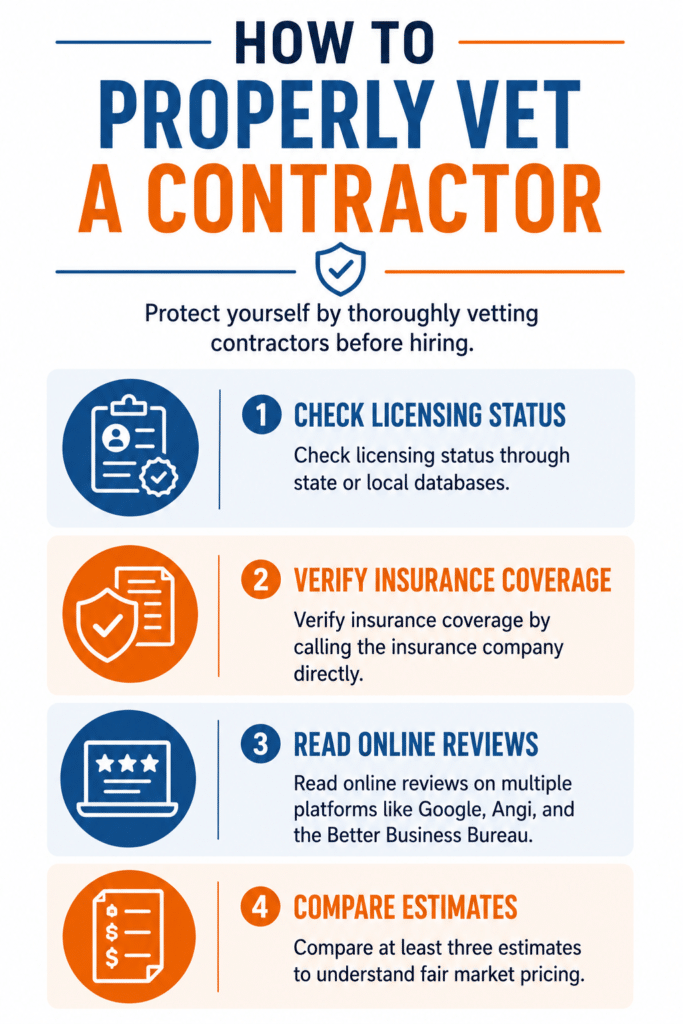
Protect yourself by thoroughly vetting contractors before hiring.
- Check licensing status through state or local databases.
- Verify insurance coverage by calling the insurance company directly.
- Read online reviews on multiple platforms like Google, Angi, and the Better Business Bureau.
- Compare at least three estimates to understand fair market pricing.
Trust your gut. If something feels off during your first meeting, it probably is. Do not hire someone who makes you uncomfortable, even if the price looks good. A design build remodel approach, where one team handles design and construction under a single contract, also removes some of the coordination risk that shady subcontractors can hide behind.
Our how to find a bathroom remodeling contractor guide provides more detailed vetting steps.
Questions to Ask Before Hiring
Ask contractors these questions: Are you licensed and insured? Can you provide proof of insurance? Do you have recent references I can contact? What’s your typical project timeline? Do you handle permits and inspections? What’s your payment schedule? Do you provide written contracts? How do you handle change orders? What warranty do you offer?
Listen closely to the answers. Hesitation or vague responses are red flags on their own. A good contractor answers confidently and specifically, without dodging a single question.
Frequently Asked Questions
What are red flags when hiring a contractor?
Major red flags include no license or insurance, refusal to provide references, suspiciously low bids, large upfront payment demands, no written contracts, poor communication, and unwillingness to handle permits. Any of these should make you reconsider hiring that contractor.
How do you know if a contractor is trustworthy?
Trustworthy contractors have active licenses, current insurance, positive reviews from multiple sources, verifiable references, clear communication, reasonable payment terms, and written contracts. They answer questions directly and don’t pressure you into quick decisions.
What should you ask a contractor before hiring them?
Ask about licensing, insurance, references, timeline, payment schedule, permit handling, contract terms, and warranties. Also ask how they handle problems, change orders, and communication during projects. Their answers reveal professionalism and reliability.
How much should you pay a contractor upfront?
Standard deposits run 10% to 20% to cover materials and secure scheduling. Never pay more than 25% upfront. Avoid contractors demanding half the total before any work has started.
Should you hire a contractor without a written contract?
Never. Verbal agreements offer no protection. A written contract documents every promise made and provides you with legal recourse if the project goes sideways.
How do you verify a contractor’s license and insurance?
Request a certificate of insurance showing current coverage. Verify this by calling the insurance company directly using contact information you find independently, not just the phone number the contractor provides.
What are common contractor scams homeowners should avoid?
Common scams include taking large deposits and disappearing, claiming to find expensive “hidden problems” after starting, using your deposit to finish other jobs, performing shoddy work then demanding full payment, and adding charges not in the original agreement.
Hire With Confidence
Spotting contractor red flags protects your home and your wallet. Builders Group Construction has served Dayton and surrounding Ohio communities including Hamilton, Brookville, and Centerville with honesty and quality for decades. We are licensed, fully insured, and provide clear contracts and communication from the very first call. If you are still gathering ideas before you start interviewing anyone, our roundup of kitchen remodel ideas and thoughts on the best time to renovate your home are worth a look too.
Ready to work with a contractor you can actually trust? Call us at 937 800 4409 or schedule your free consultation today. Let’s talk through your project the right way.