If you served in the military, you may be eligible for a VA home construction loan. Rather than purchasing an existing home, you can build a new one with no down payment in most cases, no private mortgage insurance, and the freedom to customize your home.
This guide explains how VA construction loans work in Dayton, step by step. If you are ready to start building, Builders Group Construction is a VA-approved builder in Dayton who can walk you through the entire process.
What Is a VA Construction Loan?
A VA construction loan lets eligible veterans and active-duty service members finance the construction of a new home. The Department of Veterans Affairs backs the loan, which gives lenders confidence to offer better terms.
Unlike a standard VA loan used to buy an existing home, a VA construction to permanent loan covers the cost of building a new home from the ground up. Once construction is complete, it automatically converts into a permanent VA mortgage.
The home must be your primary residence. You can’t use this loan to build a home or rental property.
How Do VA Construction Loans Work in Dayton?
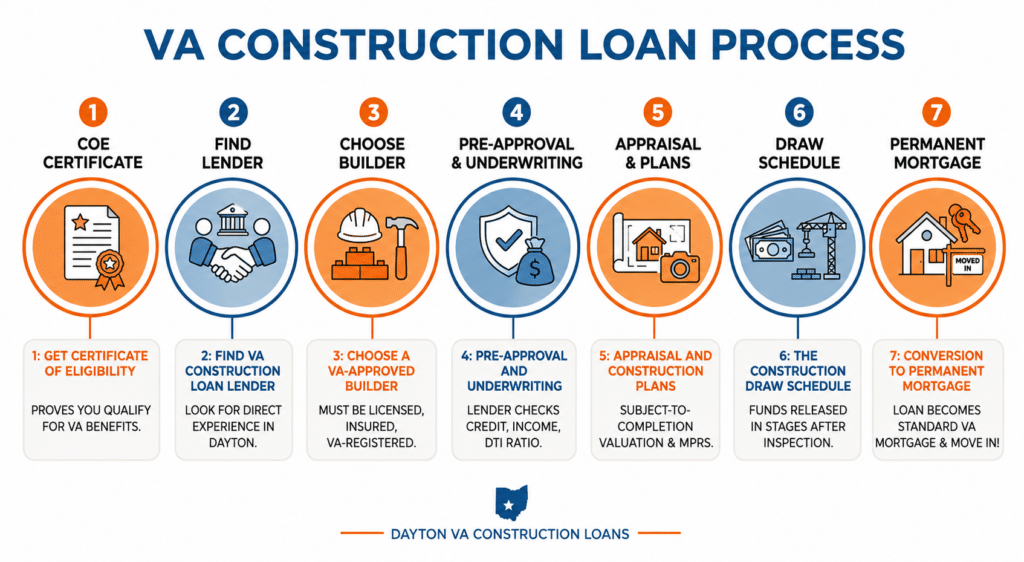
Here is the process broken down simply.
Step 1: Get Your Certificate of Eligibility
A Certificate of Eligibility for a VA loan proves you meet the requirements for VA home loan benefits. You can request it through your lender or directly from the VA. Most lenders can retrieve it quickly, but the loan process cannot continue without it.
Step 2: Find a VA Construction Loan Lender in Dayton
Not every lender offers VA construction loans. It’s a more complex product, so fewer banks and credit unions handle it. Look for lenders with direct experience in VA new construction financing, not just standard VA purchase loans. Ask them how many VA construction loans they’ve closed in the past year. That answer tells you a lot.
The Consumer Financial Protection Bureau has helpful resources to understand your mortgage rights and how to compare lenders.
Step 3: Choose a VA-Approved Builder
Working with a VA approved builder is a critical requirement. The VA requires your builder to be registered and approved before the loan can move forward. If your builder is not VA-approved, the loan cannot receive VA backing.
A VA-approved builder must be licensed, insured, and registered directly with the VA. Builders Group Construction meets all of these requirements. Our team handles the registration paperwork and works directly with your lender to keep things moving without delays.
Step 4: Pre-Approval and Underwriting
Your lender will look at your credit score, income, debt-to-income ratio, and residual income. Most VA lenders want a credit score of at least 620. Residual income is the money left over after all monthly bills are paid. The VA uses this number to make sure you can afford the home long-term.
Get your documents ready early. Pay stubs, tax returns, and bank statements are standard.
Step 5: Appraisal and Construction Plans
Before a VA construction loan is approved, the VA requires a subject-to-completion appraisal. An appraiser evaluates your construction plans and estimates the home’s value once it’s finished. The loan amount is based on that projected value.
Your plans must also show the home will meet VA Minimum Property Requirements. BGC helps clients remodeling homes that meet these standards from the start, which avoids delays later.
Step 6: The Construction Draw Schedule
This is how money is released during the build. Rather than getting one lump sum, funds are released in stages called draws. Each draw happens after a completed phase is inspected and approved.
A typical draw schedule looks like this:
| Phase | Payment Released |
| Foundation complete | Draw 1 |
| Framing complete | Draw 2 |
| Rough mechanical done | Draw 3 |
| Drywall and interior | Draw 4 |
| Final completion | Draw 5 |
Inspections happen before each draw is released. This protects both you and the lender.
Step 7: Conversion to Permanent Mortgage
Once construction is complete, a VA construction to permanent loan converts into a standard VA mortgage. A final inspection confirms the home is finished and meets all requirements. After approval, you receive the keys, move in, and begin making monthly payments on the permanent loan.
One-Time Close vs Two-Time Close
| Feature | One-Time Close | Two-Time Close |
| Number of closings | One | Two |
| Closing costs | Lower | Higher |
| Rate lock | Earlier | Later |
| Process | Simpler | More complex |
Most veterans prefer the one-time close option. You sign once, lock your rate, and avoid paying closing costs twice. BGC works with lenders who specialize in one-time close VA construction loans.
VA Construction Loan Requirements
Here is a quick checklist of what you need to qualify:
- Active-duty, veteran, or eligible surviving spouse status
- Valid Certificate of Eligibility
- Credit score of 620 or higher (varies by lender)
- Acceptable debt-to-income ratio
- Sufficient residual income
- VA-approved builder
- Approved construction plans and blueprints
- Subject-to-completion appraisal
Can You Buy Land With a VA Construction Loan?
In some cases, yes. Certain lenders allow you to include land purchase costs in a VA construction loan if the land is part of the overall home construction project. Since not every lender offers this option, ask about land financing when comparing VA construction loan providers.
Common Costs to Know
Here are fees to plan for:
- VA funding fee (typically 1.25% to 3.3% of the loan amount)
- Appraisal fee
- Construction draw inspection fees
- Builder deposit
- Interest reserve account (covers interest during the build)
The good news is there’s no PMI and usually no down payment. That saves a significant amount compared to conventional construction loans.
Why VA Construction Loans Are Harder to Get
VA construction financing involves a more detailed lending process. Underwriting is more involved, builder registration adds an extra step, and construction carries greater risk than a standard home purchase. Because of these factors, fewer lenders provide this type of financing.
The fix is simple. Work with a builder and lender who already know the process. BGC has worked through VA construction financing many times. Our design-build remodeling and construction services are built around keeping clients informed and on track.
VA Construction Loan Timeline
| Phase | Estimated Time |
| Pre-approval | 1 to 2 weeks |
| Builder approval | 2 to 4 weeks |
| Underwriting | 2 to 3 weeks |
| Construction | 6 to 12 months |
| Final conversion | 1 to 2 weeks |
Plan for the full process to take about 8 to 14 months from start to move-in.
Frequently Asked Questions
Do VA construction loans require a down payment?
In most cases, no. That’s one of the biggest benefits of using your VA benefit to build.
What credit score do I need?
Most lenders want at least 620. Some may go lower depending on other factors.
Can I use any builder?
No. The builder must be registered with the VA. BGC serves Dayton and nearby cities including Beavercreek, Kettering, and Tipp City.
How long does construction take?
Most new builds take 6 to 12 months depending on size and design.
Is a VA construction loan worth it?
For most veterans who want a custom home, yes. No down payment and no PMI make it one of the most affordable ways to build.
Ready to build? Call BGC at 937-800-4409 or request your free consultation at bgcnow.us.